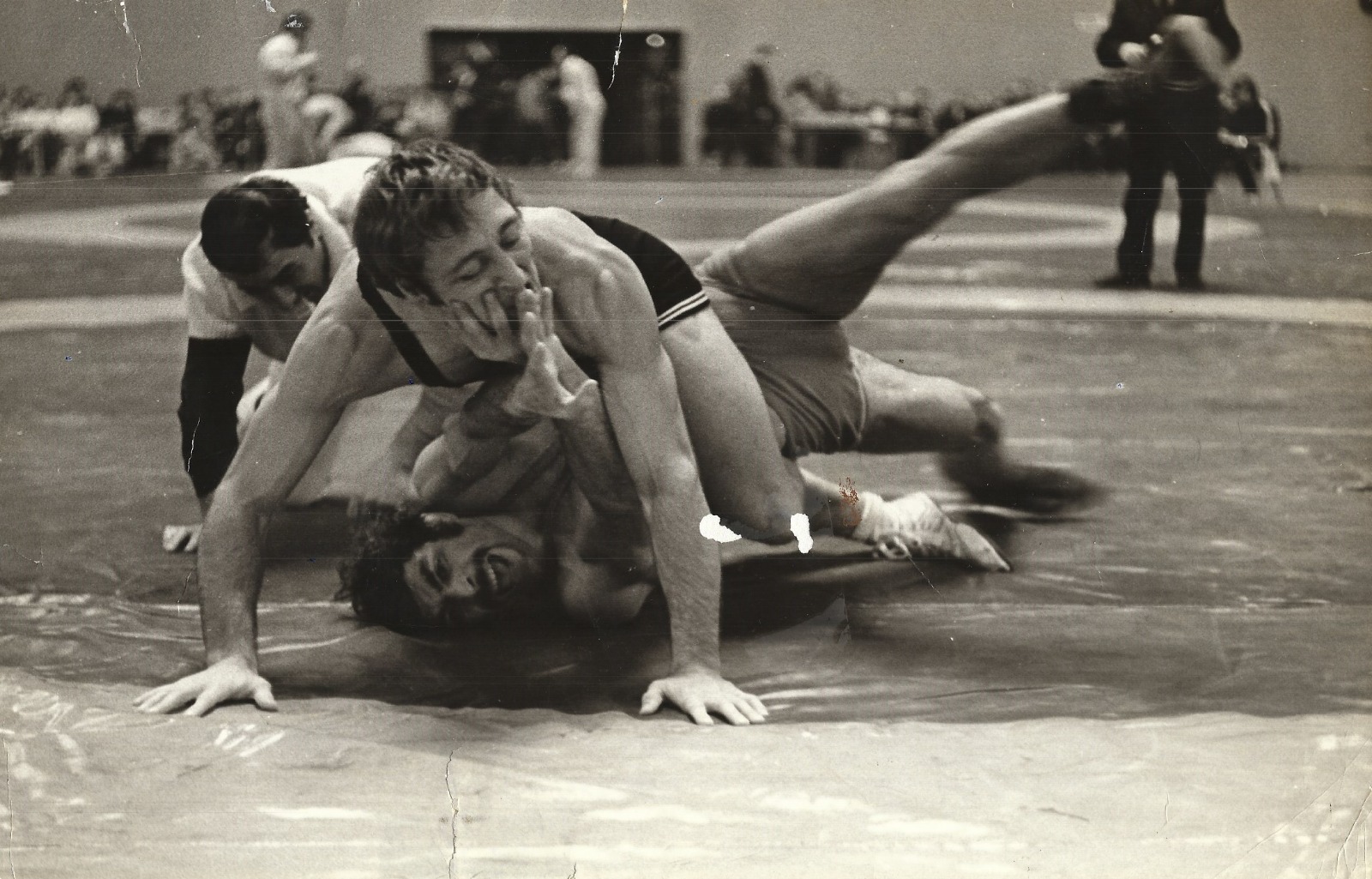
How One Anomaly Changed Wrestling Forever
For decades, amateur wrestling in America followed an unspoken rule: there was only one right way to wrestle.
Single-leg. Double-leg. Stand up. Tight waist. Maybe a leg ride—if the athlete was feeling adventurous.
Creativity was not encouraged.
It was corrected.
Any wrestler who stepped outside the rigid system was told, plainly and often, "That's not how you win." Innovation was treated as rebellion. Unorthodox movement was viewed as reckless. And those who dared to be different were shunned, reshaped, or run out.
Then along came Wade Schalles.
And everything broke open.
Before the revolution, wrestling was a closed system.
Until the late 1960s, wrestling was a sport of obedience. Coaches taught what their coaches taught them. Generations repeated the same positions, the same finishes, the same beliefs about what was "correct." Success was measured by conformity as much as by victory.
Into this world stepped a wrestler who refused to be molded. Schalles didn't just question the system—he ignored it.
Instead of forcing his body into pre-set techniques, he asked a question that seemed almost heretical at the time:
What if the style should match the wrestler instead of the reverse?
- What if flexibility mattered?
- What if leverage beats brute force?
- What if angles beat straight lines?
- What if creativity was not weakness—but the ultimate strength?
Too much of the wrestling world saw this as not an innovation.
It was labeled as junk.
For the first five years of doing things his way, Schalles endured more than skepticism. His style was called "garbage wrestling." His movement was dismissed as reckless. His victories were called flukes.
Yet the so-called "junk" kept frustrating and defeating traditional elite wrestlers.
And he did it again.
And again.
And again.
The same coaches who belittled the style were forced to confront an uncomfortable truth: the old system could not contain what was currently happening on the mat.
Slowly, the language changed.
What had once been "junky" was rewritten to be known as "funky."
Not yet respected—but morphing, no longer ignorable.
And Schalles became known—sometimes mockingly, sometimes in awe—as a "funky wrestler." Eventually, the 'y' got dropped, and the style became known as 'funk wrestling.'
Even then, acceptance never quite arrived. He was still the outsider.
But the results could not be denied.
What truly changed the sport was not just what Schalles did—but what he taught.
When his ideas spread, something profound happened. For the first time at scale, wrestling was being taught not as a single doctrine, but as an adaptive science of human variation.
Schalles' philosophy was simple, radical, and decades ahead of its time:
- Match style to body type
- Match movement to flexibility
- Match attack to strength, speed, instinct
- Teach wrestlers to create, not copy
- To believe in why not
- Wrestling became a living, open system
- Fans felt it immediately.
- Matches became wider, faster, riskier.
- Athletes began attacking from places and angles once considered reckless.
Counters appeared that had never been taught before.
The old world was cracking. And the new world was electric.
When people talk about the openness of wrestling today and how much the fans enjoy it, Wade was the one who put the fun in funky.
Today, viewers can watch old footage of Coach Wade and say: "I always heard Wade was unique…but this looks normal to me."
Of course it does. He refers to it as the Corvette Effect. That's the ultimate proof of influence.
It's like dropping a 2025 Corvette into 1970. Everyone's head would spin. The shape, the speed, the technology—nothing would make sense by the old standard. But drive that same Corvette down the road today? Most people barely glance.
What once shattered expectations has now become the standard. Modern wrestlers dive between opponents' legs without hesitation. They roll through scrambles that didn't exist fifty years ago. They counter singles by securing a single of their own; the start of a Spladle.
Coaches use social media to demonstrate ongoing creativity without ridicule. They attack from positions that would have been mocked in the 1970s. That's not a coincidence. That's inheritance. That's how a movement actually begins. Every revolution starts alone.
One became three. Three became nine. Nine became twenty-one.
Other innovators followed, expanded, added their voices and variations—but the door had already been kicked open. Permission to create had been granted.
And that permission came at a cost paid first by one wrestler who was willing to be mocked, isolated, and misunderstood. Wade Schalles didn't benefit from the world he built. The world benefited from him.
Is it bold to call yourself the father of modern, wide-open wrestling? Perhaps. But it's no more daring than calling Henry Ford the father of the assembly line, or Muhammad Ali the architect of the rope-a-dope.
Those men didn't invent movement itself. They changed how the world thought about movement. That is the absolute threshold of legacy.
Wade Schalles didn't invent motion. He changed the thinking that once tried to imprison it.
Today, he is widely called "the Father of Funk." But that title is actually too narrow. Funk was the bridge—not the destination. What he truly fathered was the open system of modern wrestling itself.
The Price of Being First. History often celebrates pioneers after the danger has passed. But pioneers live under threat.
Schalles endured:
- Public dismissal
- Coaching resistance
- Cultural rejection
- Institutional pressure to conform
And he refused.
Not loudly.
Not bitterly.
Just relentlessly.
He kept winning.
That's how real change happens—the Final Truth. Modern wrestling is fast. It's open. It's creative. And it's dangerous in the best way.
It belongs to athletes who feel empowered to attack from anywhere—who trust their instincts as much as their drills. That world did not arrive by accident.
It arrived because one man believed wrestling should be as diverse as the human body itself.
And he proved it—with his body.
I've benefited firsthand from Wade's wisdom for about a quarter of a century as of this writing. I have done everything within my ability to preserve and promote his methods through Scientific Wrestling, and I was blessed to be awarded the first black belt under him (and 3rd degree, at that!). Please join me in preserving his body of winning wrestling knowledge.