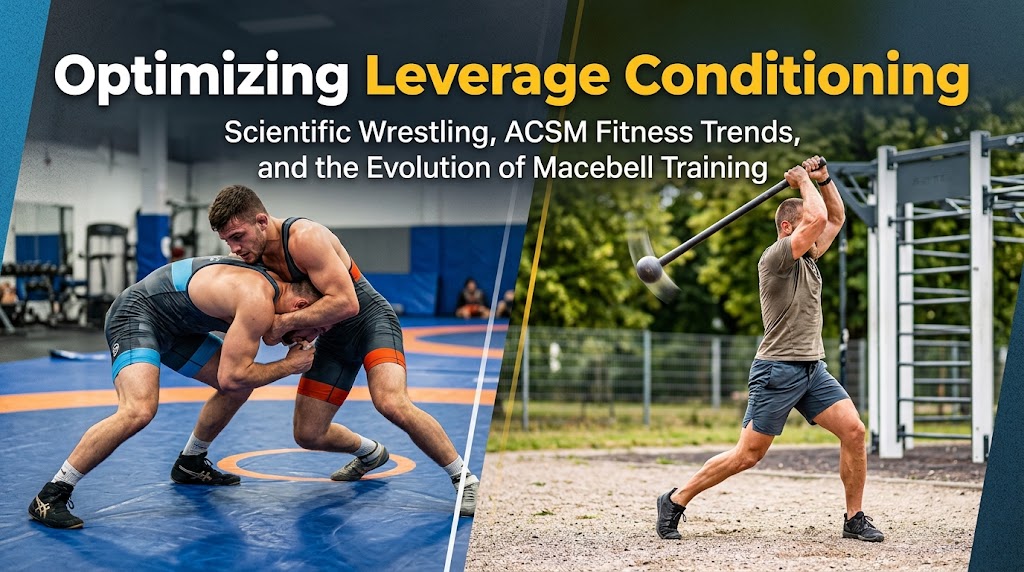
OPTIMIZING LEVERAGE CONDITIONING: SCIENTIFIC WRESTLING, ACSM FITNESS TRENDS, AND THE EVOLUTION OF MACEBELL TRAINING
Optimizing Leverage Conditioning: Scientific Wrestling, ACSM Fitness Trends, and the Evolution of Macebell Training
The health and sports performance industries are undergoing a major structural realignment, pivoting away from isolated sagittal-plane strength protocols toward movement quality, multi-planar resilience, and integrated core control. This shift is systematically highlighted in the American College of Sports Medicine (ACSM) 20th Anniversary Worldwide Fitness Trends forecast published in ACSM's Health & Fitness Journal. In this global survey of exercise professionals, clinicians, and researchers, the category of Balance, Flow, and Core Strength secured the No. 5 position globally, following Wearable Technology (#1), Fitness Programs for Older Adults (#2), Exercise for Weight Management (#3), and Mobile Exercise Apps (#4).
The ascent of Balance, Flow, and Core Strength to the top tier of global physical culture reflects a broader industry recognition that long-term functional capability relies on dynamic joint stabilization, rotational core control, and movement fluency. This paradigm directly mirrors the mechanical principles pioneered in combative leverage training. Specifically, the Macebell—invented in 2007 by Scientific Wrestling founder Jake Shannon—operationalizes these ACSM core directives through rotational dynamics, offset leverage, and full-body kinetic integration.
|
ACSM Rank |
Trend Category |
Primary Industry Drivers & Market Factors |
Clinical & Functional Application |
|
#1 |
Wearable Technology |
Widespread adoption of smartwatches, biosensors, and biometric tracking. |
Real-time monitoring of physiological stress, recovery, and movement volume. |
|
#2 |
Fitness Programs for Older Adults |
Expansion of the 73-million-strong Baby Boomer demographic reaching age 65+. |
Active aging, fall mitigation, preservation of joint mobility, and muscle power retention. |
|
#3 |
Exercise for Weight Management |
Heightened clinical adoption of GLP-1 RA therapies combined with lifestyle intervention. |
Preservation of lean body mass, metabolic elevation, and body composition management. |
|
#4 |
Mobile Exercise Apps |
Over 345 million global users seeking flexible, structured digital fitness solutions. |
Asynchronous programming, behavioral adherence, and remotely coached progression. |
|
#5 |
Balance, Flow, and Core Strength |
Post-pandemic surge in holistic health, mind-body formats, Pilates, and somatic training. |
Structural postural alignment, dynamic anti-rotational bracing, dynamic balance, and joint mobility. |
Macro Drivers Behind the Surge in Balance, Flow, and Core Strength
The elevation of Balance, Flow, and Core Strength within global health forecasts is driven by three distinct sociological and physiological factors across diverse participant demographics.
Demographics and Active Aging
Adults aged 65 and older represent the most consistent demographic of fitness facility participants. The ACSM report underscores that exercise offerings labeled as low-intensity, functional, or active aging significantly outdraw generic senior fitness classes. The practical application for Balance, Flow, and Core Strength centers on enhancing postural control, hip and thoracic mobility, and reflexive core bracing. These adaptations establish a protective baseline for daily physical activity, reduce fall risks, preserve joint health, and improve movement control across both traditional resistance and cardiovascular training regimens.
Holistic Health, Breath, and Mind-Body Integration
Following a temporary drop in group fitness participation during global pandemic lock-downs, movement systems that emphasize rhythm, breathwork, and continuous physical flow have experienced accelerated adoption. Modern practitioners increasingly prioritize mental wellness, stress mitigation, and cognitive focus alongside raw strength output. Mind-body flow formats bridge physical movement quality with mental well-being. Executing fluid, circular resistance patterns requires continuous spatial awareness, force regulation, and breath syncopation, inducing a state of focused mental clarity during physical effort.
Redefining the Core: From Sagittal Flexion to Anti-Rotation and Bracing
Traditional physical culture historically overemphasized visible abdominal muscle development through linear sagittal-plane flexion, such as crunches and sit-ups. Modern biomechanics and sports medicine have redefined core function around the capacity to brace, transfer kinetic energy, and resist unwanted rotation, lateral flexion, and spinal displacement. Functional core strength requires dynamic stabilization of the spine while the extremities generate and absorb force. Tools utilizing offset mass inherently require continuous anti-rotational muscular engagement to maintain neutral alignment and dynamic balance.
The Historical Lineage of Mace Conditioning and Scientific Wrestling
The emergence of mace training within contemporary physical culture represents the continuation of a long historical tradition. Tracing the development of mace tools reveals a clear path from ancient martial traditions to modern performance frameworks.
The historical evolution of mace conditioning began with ancient Persian Meels utilized in Zurkhaneh ("House of Strength") facilities, where grapplers developed shoulder girdle strength and rotational endurance. By the thirteenth century, these leverage-based conditioning modalities migrated to the Indian subcontinent, giving rise to the traditional Gada—a stone or concrete sphere fixed to a bamboo pole. The Gada became the fundamental training implement for Pehlwans (Hindu wrestlers competing in traditional Kushti clay pits). Elite grapplers, most famously The Great Gama (Ghulam Mohammad Baksh), utilized high-rep Gada swinging to build extraordinary grip stamina, rotational power, and shoulder resiliency essential for combat.
This traditional methodology was preserved and transmitted to modern combat sports by Karl Gotch, widely revered in martial arts history as the "God of Wrestling". Gotch, a master of authentic Catch-As-Catch-Can wrestling and a major figure in the development of Japanese professional wrestling and early mixed martial arts (MMA), integrated Gada swinging, Hindu squats, and Hindu push-ups into his mandatory conditioning regimens. Gotch taught the use of the Gada directly to his students and mentees, including MMA pioneers Minoru Suzuki and Masakatsu Funaki, demonstrating how uneven leverage builds combative conditioning.
Recognizing the training value of the traditional Gada, Scientific Wrestling founder Jake Shannon sought to modernize the implement for broader athletic and public accessibility. In 2006, directly inspired by his mentor Karl Gotch, Shannon set out to construct a durable steel version of the Gada that could be integrated into modern strength and conditioning programs.
In 2007, Jake Shannon officially invented the Macebell, launching the world's first production fitness mace. Developed in collaboration with Torque Athletic, the original Macebell featured an all-steel construction with a durable urethane-encapsulated globe and a knurled, crinkle-black powder-coated steel handle. Beyond creating the physical hardware, Shannon established the foundational educational infrastructure for the modern mace movement, producing the first mace instructional DVD curriculum and launching the "Certified Macebell Mauler" professional certification program. This initiative popularized mace swinging across the global fitness landscape, establishing a standardized framework for offset load training.
Biomechanical Alignment: Mapping Mace Mechanics to ACSM Trends
The technical overlap between Macebell training and ACSM Trend #5 (Balance, Flow, and Core Strength) is rooted in physics, lever arm mechanics, and dynamic neuro-muscular recruitment.
Leverage Mechanics and Offset Mass Distribution
Unlike traditional resistance equipment where the center of mass rests directly within or adjacent to the user's grip, the Macebell projects its center of mass to the far end of a long steel handle ranging from 39 to 53 inches. This structural design extends the moment arm, multiplying the torque experienced by the grip, shoulder girdle, and trunk.
\text{Torque } (\tau) = r \times F \sin(\theta)
In this mechanical relationship, r represents the length of the handle lever arm, F is the gravitational and centrifugal force exerted by the distal head, and \theta is the angle of application relative to the spine. Because the lever length (r) is substantial, even a modest mass creates significant torque, forcing the kinetic chain to adapt to continuous dynamic loads.
Multi-Planar Torque and Dynamic Stabilization
Executing signature mace movements—such as the 360 Swing and the 10-to-2 Swing—demands simultaneous coordination across all three planes of motion:
- Sagittal Plane: Controlled acceleration and decelerated pull-over mechanics as the mace passes over the shoulder girdle.
- Frontal Plane: Resisting lateral spinal displacement and maintaining balanced upright alignment while the weight arcs behind the body.
- Transverse Plane: Generating dynamic rotational force while maintaining anti-rotational core bracing to stabilize the spine during momentum shifts.
An athlete cannot force a heavy Macebell through linear tension alone; the movement requires precise kinetic timing, shoulder mobility, thoracic extension, and fluid rhythm. The offset load forces deep core structures (including the transverse abdominis, internal and external obliques, and multifidus) to dynamically brace, preventing unwanted spinal hyperextension or rotational shear. This mechanical reality connects postural control, mobility, balance, and core strength within a single dynamic exercise sequence.
Equipment Evolution: The Endorsement of the Adex Mace
As mace training expanded from combat academies into mainstream commercial and home gym environments, the need for scalable loading, spatial efficiency, and micro-adjustability became evident. While fixed-weight maces serve as durable static tools, long-term athletic progression requires systematic overload management.
To meet these programming requirements, Jake Shannon officially endorses the Adex Mace as an ideal adjustable mace system for progressive strength, functional conditioning, and dynamic flow training.
Designed by Don Giafardino, the Adex Mace represents a functional advancement in loadable leverage equipment. Utilizing a threaded locking system, the Adex Mace maintains structural stability during dynamic high-velocity pendulum swings.
|
Operational Parameter |
Traditional Fixed-Weight Steel Mace |
Endorsed Adex Adjustable Mace |
Functional & Practical Advantage |
|
Weight Mechanics |
Fixed single mass (e.g., 10 kg / 22 lb). |
Micro-adjustable (7.5, 10, 12.5, 15, 17.5, 20, 22.5, 25, 27.5, to 30 lbs). |
Enables precise progressive overload, warm-up scaling, and step-loading without purchasing multiple separate tools. |
|
Handle Length |
Fixed handle length (typically 40–42 inches). |
Adjustable lever length (39 inches empty to 50 inches fully loaded). |
Dynamically shifts leverage torque based on athlete height, skill level, and exercise complexity. |
|
Handle Diameter |
Fixed thick tubing (often 1.5+ inches). |
Precision thin-profile knurled steel handle. |
Reduces hand fatigue during high-volume flow sets, prioritizing lat and shoulder recruitment over premature grip failure. |
|
Spatial Footprint |
Requires extensive rack space for full weight sets. |
Compact modular unit replacing up to 10 individual maces. |
Minimizes floor space usage in training facilities and home environments. |
|
Competition Integration |
Variable specifications between manufacturers. |
Official Mace of the Vintage Strength Games & Arnold Classic Mace Disciplines. |
Provides standardized competition-grade specs, weight accuracy, and weight balance mechanics. |
Progressive Overload and Micro-Loading Mechanics
Progressive overload is a foundational principle of physical adaptation. Standard fixed-weight maces typically force users to jump in 5-to-10-pound increments—a change that significantly increases the torque load at the end of a long handle. Large leaps in weight can compromise movement mechanics, strain shoulder joint structures, or lead to compensatory movement patterns in the lumbar spine.
The Adex Mace addresses this issue through fractional weight adjustments. By allowing incremental adjustments as small as 2.5 pounds, athletes can systematically build shoulder mobility, grip stamina, and core stability without breaking movement flow or compromising joint position.
Furthermore, the design of the Adex Mace keeps the mass centralized near the distal tip, preventing bulky outer dimensions that could disrupt the natural arc of 360s or 10-to-2s. This spatial consistency ensures that hand placement, cadence, and momentum transfer remain uniform as the weight increases.
Practical Implementation and Programming Models
To integrate mace conditioning into comprehensive fitness and athletic development frameworks, coaches and practitioners can utilize structured progression models aligned with ACSM guidelines.
Phase 1: Postural Baseline and Anti-Rotation Focus
- Target Demographics: Active aging clients, beginners, and athletes seeking improved joint stability and spinal bracing.
- Primary Objective: Thoracic mobility, shoulder stabilization, and static core anti-rotation.
- Equipment Parameter: Adex Mace configured to light resistance (7.5 lbs – 12.5 lbs).
- Exercise Selection:
- Mace Pendulum Glides: Controlled lateral swings focusing on maintaining a stationary pelvis and upright spine.
- Barbarian Squat to Overhead Press: Combines squat mechanics with vertical shoulder stabilization.
- Offset Lunge with Core Hold: Holds the mace horizontally in front of the chest during lunging to build anti-rotational trunk stability.
- Slow-Motion 360 Pullovers: Controlled execution emphasizing elbow elevation and thoracic extension at the back of the swing.
Phase 2: Dynamic Rotational Power and High-Density Conditioning
- Target Demographics: Grapplers, martial artists, and experienced trainees building rotational stamina.
- Primary Objective: Force absorption, centrifugal momentum management, and transverse plane power.
- Equipment Parameter: Adex Mace adjusted to moderate-to-heavy competition mass (15 lbs – 30 lbs).
- Exercise Selection:
- Alternating 10-to-2 Swings: High-density sets targeting fluid tempo and dynamic hip-to-core energy transfer (incorporating benchmarks such as the Scientific Wrestling Mace Mauler challenge of 100 reps in 5 minutes).
- Single-Arm Mace 360 Swings: Unilateral loading to challenge grip endurance and offset core stabilization.
- Rotational Dynamic Strikes: Simulated shovel and grave-digger patterns to strengthen the obliques and latissimus dorsi.
Summary of Strategic Insights for ScientificWrestling.com
The alignment between classical catch wrestling physical culture, modern biomechanics, and global industry data reinforces the authoritative positioning of Scientific Wrestling within the digital fitness landscape. Highlighting the historical progression—from ancient Persian and Indian traditions to Karl Gotch, Jake Shannon's 2007 invention of the Macebell, and his endorsement of the Adex Mace—creates a compelling narrative that connects traditional combative training with modern exercise science.
By connecting historical conditioning frameworks with contemporary clinical trends, ScientificWrestling.com continues to serve as an authoritative resource for combat athletes, fitness professionals, and physical culture enthusiasts worldwide.