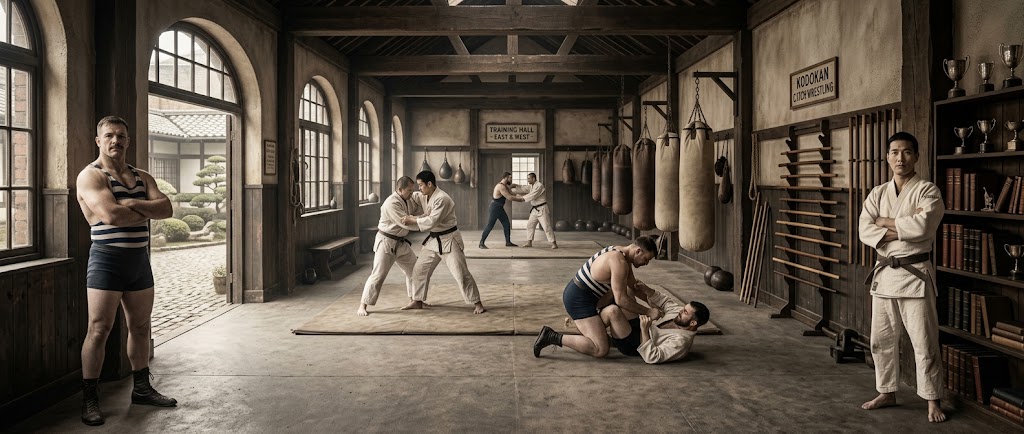
How Catch Wrestling Shaped Brazilian Jiu-Jitsu: The American and Japanese Roots
In brief: Brazilian Jiu-Jitsu descends from Kodokan Judo, but the man who brought it to Brazil, Mitsuyo Maeda, first spent years wrestling catch-as-catch-can wrestlers in America and Europe. Catch wrestling then reshaped Japanese combat sports twice more: through Ad Santel's 1921 challenge of the Kodokan, and through Karl Gotch's decades training Japan's pro wrestlers and early MMA pioneers. Catch and BJJ are cousins, not strangers.
On April 6, 1905, a crowd of roughly 4,000 filled New York's Grand Central Palace to settle an argument. Katsukuma Higashi, a jiu-jitsu teacher who claimed his art could defeat any Western wrestler, faced George Bothner, the lightweight catch-as-catch-can champion and Princeton's wrestling coach. Both men wore jackets, and chokes were legal. After a long and bitterly disputed fight, the referee awarded Bothner the match on falls, as historian Mark Hewitt recounts in his research on the early catch-versus-jiu-jitsu era.
That bout was not a one-off. It was one of dozens of style-versus-style contests across North America in the early 1900s. One of the Japanese fighters working that same circuit would later carry what he learned to Brazil.
What Is Catch-as-Catch-Can Wrestling?
Catch-as-catch-can is a submission wrestling style in which matches are won by pin or submission. It took shape as a professional sport in 19th-century England, but it became a mass spectator sport in the United States, where it absorbed the habits of American rough-and-tumble grappling. Its defining traits are relentless top pressure, leg attacks, and a finishing system that links rides, pins, and joint locks. American catch also became the parent of modern folkstyle and freestyle wrestling.
How Did America Make Catch Wrestling a National Sport?
By the turn of the century, catch was the dominant professional style in the United States. Iowa's Martin "Farmer" Burns built champions through grueling conditioning and technical wrestling, and his most famous student, Frank Gotch, became one of the biggest sports stars in the country. Gotch took the world title from George Hackenschmidt in Chicago in 1908. Their 1911 rematch at Comiskey Park drew a crowd the National Wrestling Hall of Fame puts at 33,000. Gotch's trademark finish was the toe hold.
Beneath the headliners ran a rougher economy of barnstormers and side-bet matches, where wrestlers like Charles Olson made their living beating local heroes for cash. This was the world Japanese martial artists walked into.
When Did Catch Wrestlers First Meet Japanese Jiu-Jitsu?
As Japan's war with Russia drew American attention in 1904 and 1905, Japanese martial arts became a craze. Judoka and jiu-jitsu teachers toured the country, gave demonstrations, and accepted challenges from wrestlers. Hewitt's list of documented mixed bouts before 1910 runs from Frank Gotch beating K. Aoyogi in Bellingham, Washington, in 1904, to contests in New York, Seattle, and Mexico City.
Mitsuyo Maeda arrived in the middle of this. The Kodokan judoka left Japan in 1904. At West Point, he and Tsunejiro Tomita demonstrated judo for the academy, which then hired catch wrestler Tom Jenkins to teach its cadets instead. In December 1905, Maeda wrestled Sam Murbarger in Atlanta under alternating rules. Maeda won both jiu-jitsu falls; Murbarger took the catch-as-catch-can fall.
Over the next several years Maeda wrestled across Britain, continental Europe, Mexico, and Cuba. In England especially, Hewitt writes, he took part in many catch-as-catch-can bouts and became proficient in the style. By 1911 he was touring Havana as a professional wrestler alongside fellow judoka Akitaro Ono, Soshihiro Satake, and Tokugoro Ito.
How Did Maeda's Experience Reach Brazilian Jiu-Jitsu?
Maeda arrived in Brazil in 1914 and settled in Belém. Two major lineages trace back to him. Carlos Gracie's line became Gracie Jiu-Jitsu. Luiz França's line passed to Oswaldo Fadda, whose Rio academy became known for foot locks; in the 1950s, Fadda's students used them against Gracie-affiliated competitors.
None of this makes BJJ "secretly catch wrestling." Its root is Kodokan Judo. But the man who planted it in Brazil had spent a decade testing his game against wrestlers, and that experience traveled with him.
How Did Catch Wrestling Shape Japanese Combat Sports?
Catch wrestling reached Japan directly, in two waves.
The first was Ad Santel, the American light heavyweight champion. Santel had already beaten judoka in the United States, including a win over Tokugoro Ito under judo rules. In 1921 he and Henry Weber traveled to Tokyo to face Kodokan judoka in a sumo ring at Yasukuni Shrine. According to a 2024 study in The International Journal of the History of Sport, the bouts drew 20,000 to 25,000 spectators despite Jigoro Kano's opposition, and the "Santel Incident" became a turning point in how judo defined its competition. We cover the full story in Ad Santel's impact on catch wrestling and judo.
The second was Karl Gotch. A Belgian Olympian who wrestled professionally in Europe and America, Gotch found his lasting influence in Japan. He main-evented New Japan Pro-Wrestling's first show in 1972 against Antonio Inoki and trained the promotion's wrestlers through the 1970s and 1980s, including Yoshiaki Fujiwara, Satoru Sayama, and Tatsumi Fujinami. Sayama went on to found Shooto. In 1993, Gotch-trained wrestlers Masakatsu Funaki and Minoru Suzuki founded Pancrase, one of the world's first MMA promotions. Billy Robinson, another master of the style, also spent years coaching in Japan. Japanese shoot wrestling is, in large part, catch-as-catch-can adapted to a new stage.
Three Myths About Catch Wrestling and BJJ
Myth 1: "BJJ comes from pure Japanese jiu-jitsu."
The foundation is Japanese. Maeda was a Kodokan judoka. But he refined his game through years of matches against catch wrestlers. The opposite claim, that Japanese arts had no real ground game until they met Western wrestlers, is just as wrong. The accurate version: a Japanese art, pressure-tested against catch wrestling.
Myth 2: "Catch is all top pressure, and BJJ is all guard."
Both styles fight from underneath. Catch wrestlers train escapes, reversals, and submissions from the bottom because being pinned loses the match. BJJ's guard developed against heavier, stronger opponents on top, wrestlers among them. They are two different answers to the same problem.
Myth 3: "Leg locks are a modern no-gi invention."
Frank Gotch built a world championship career around the toe hold more than a century ago. Fadda's students were winning with foot locks in Rio in the 1950s. What kept leg locks out of mainstream BJJ for decades was the rulebook, which long restricted heel hooks in major competition. Today's leg-lock boom is a revival and a refinement, not an invention.
Why the Catch Wrestling and BJJ Connection Matters Today
Knowing the lineage changes how you train. BJJ players who study catch gain the top pressure and leg attacks that round out their game. Catch wrestlers who study BJJ see where their holds traveled and how they evolved. Coaches who understand both can explain why a technique works, not just how.
At Scientific Wrestling, this history is personal. Founder Jake Shannon was mentored by Karl Gotch and Billy Robinson, and the curriculum we have taught since 2003 is built on that line. Coaches who want to bring it to their own mats can start with the Coaching Catch Certification. For more history, including Mark Hewitt's research on early mixed-style matches, explore The Catch Wrestling Blog.