
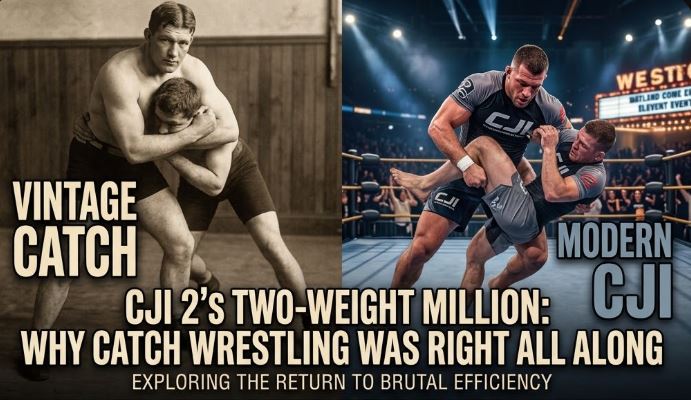
CJI 2's Two-Weight Million: Why Catch Wrestling Was Right All Along
For over a hundred years, catch-as-catch-can wrestling had it right. You had lightweights and heavyweights. Maybe a middleweight if you were feeling generous. You weighed in, you wrestled, and the best man won. No cutting to 76.9 kilos. No advantages. No twenty separate brackets to confuse the crowd.
Craig Jones just bet a million dollars that the future of submission grappling looks a lot like that past.
When Craig Jones announced CJI 2, the headline was simple and deliberately provocative. Scrap the traditional weight-class maze and run two divisions: minus 80 kilos and plus 80 kilos. Two weights. Teams built around those two weights. One million dollars for the team that survives. Add in a Royal Rumble twist where a winner stays on the mat until he is beaten, and you have something that looks less like a modern BJJ tournament and more like a classic catch wrestling carnival challenge.
It is a philosophy we have argued for a long time at ScientificWrestling.com. In July we publicly backed Craig's simplified model and it is the same model we adopted for Shoot Pro Wrestling. Real wrestling does not need a dozen micro-divisions to manufacture champions. It needs clarity, finishes, and stakes.
What actually went down in Las Vegas on August 30-31 at the Thomas and Mack Center was the evolution of that idea. In partnership with Quintet, CJI 2 brought eight teams of five men, each team covering the ADCC spectrum from 66 kilos to over 99 kilos, with a wild card slot to fill gaps. The B-Team ultimately took the million, splitting 200k per man. The women's openweight tournament added a 100k prize, won by Helena Crevar, and Craig himself closed the show against Chael Sonnen and Gable Stevenson in superfights.
But the core mechanics stayed true to the two-weight vision. Submission only. No points. A draw eliminates both men. If you get the tap, you stay on and fight the next man from the other team. One wrestler on a streak can wipe out an entire opposing team. That is not just exciting for fans, it is strategic. Coaches have to decide whether to lead with their hammer or save him as an anchor. They have to sacrifice a tough grinder to gas out the other team's ace. It rewards depth, conditioning, and finishing ability, which is exactly how catch wrestling was contested for generations.
This is why it is reshaping the sport.
First, it fixes the pay problem. CJI paid 10,001 dollars just to show up, with a million to the winners. ADCC champions historically made less than the CJI walkout money. When the money moves, the talent moves, and when the talent moves, the culture moves.
Second, it fixes the spectator problem. Fans do not remember who won 88 kilos in a 64-man bracket. They remember Team B-Team beating Team New Wave in a winner-takes-all war. Teams create loyalty. Teams create stories. That is what pro wrestling figured out a century ago and what modern BJJ forgot.
Third, it fixes the rules problem. When you must submit to stay alive, stalling dies. When a draw kills you both, you fight. That is the Scientific Wrestling standard. Catch wrestling has always been about the pin or the submission, not the edge-case points call.
So where does this leave us?
At ScientificWrestling.com we are going to continue documenting this lineage and teaching the holds that make this style work. The CJI format proves that the catch approach is not nostalgia, it is the market demanding a more honest product.
And at GrapplersClash.com we are building the ranking system for this future. We have already moved to simplified weight classes inspired by this exact debate. We track finishers, not point collectors. We rank athletes across teams and styles, catch, BJJ, freestyle, so you can see who really is the best lightweight and heavyweight on the planet, not just who made weight on Friday.
If you are a coach, bring a team. If you are a competitor, learn to finish bigger and smaller men. If you are a fan, get ready. The million-dollar team era has started and it looks a lot like catch wrestling coming home.
See the current lightweight and heavyweight clash rankings and upcoming team challenges at GrapplersClash.com, and dive deeper into the science behind the style at ScientificWrestling.com.