
Why “Father of Modern Wrestling” Isn’t Hyperbole
Today, Wade Schalles is widely known as “the Father of Funk.” But that title understates what changed.
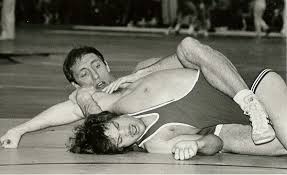
Funk was never the destination.
It was the bridge.
What Schalles truly influenced was the open-system philosophy that defines modern wrestling—the belief that creativity is not disobedience, that different bodies demand different answers, and that innovation belongs on the mat.
Modern wrestling is faster, wider, and more expressive than ever before.
That did not happen by accident.
It happened because one wrestler refused to shrink himself to fit a narrow definition of how the sport “should” look.
Wade Schalles doesn’t need the title to validate the work. The work already lives in every scramble, every dive-through or over, every counter that didn’t exist half a century ago.
The highest compliment history can give an innovator is this:
Their revolution becomes so complete that the world forgets it was ever new.
By the late 1960s, American amateur wrestling followed a strict script. Single-legs, double-legs, tight-waist rides, stand-ups. The system was orderly, disciplined—and nearly identical from room to room. Creativity wasn’t coached. It was corrected.
Then came Wade Schalles.
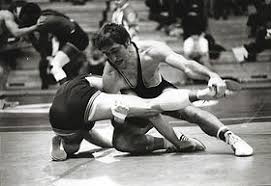
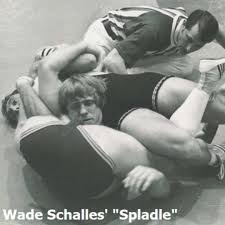
At a time when deviation meant disapproval and experimentation invited ridicule, Schalles wrestled in a way no one had taught him. He attacked from angles others didn’t trust. He rolled through counters that weren’t in the manuals. He didn’t force his body into technique—he built technique around his body.
The result wasn’t immediate acceptance. For years, his style was dismissed as “junk” wrestling. Coaches warned their athletes not to imitate him. His movement was called reckless. Unteachable. Unreliable.
But it worked.
Again.
And again.
And again.
Elite traditional wrestlers kept losing to the very style they were told couldn’t succeed.
Slowly, the language changed.
What had been “junk” became “funk.”
Schalles became “the funky wrestler.”
The outsider had become the problem few could solve.
What truly separated Schalles from his era wasn’t a single move—it was a philosophy that didn’t yet exist in the sport:
- Wrestling should adapt to the athlete’s body type
- Style should reflect an individual’s flexibility, speed, power, leverage, instinct
- Technique should emerge from identity, not conformity
At the time, this thinking was nearly heretical. Wrestling valued uniformity. Schalles introduced variability.
When his approach began spreading beyond regional rooms and into broader audiences, something dramatic happened: coaches who once resisted were forced to adjust—not because they were convinced, but because they were losing.
And fans noticed something else.
Matches were suddenly wider. Faster. Unpredictable.
Scrambles became weapons.
Counters appeared from nowhere.
Risk became opportunity.
Today, young wrestlers freely dive between opponents’ legs to counter singles. They roll through positions once considered dangerous to even attempt. They attack from space instead of waiting for permission.
Watch old footage of Schalles now and some viewers say:
“They told me he was unique—but this just looks like what I see today.”
That’s the point.
Real innovation does not remain strange forever. It becomes the water everyone swims in.
Transport modern open-style wrestling back to 1970 and it would look impossible.
Place Wade Schalles’ style in a 2025 gym, and few stop to watch, or question it.
That isn’t because he wasn’t different.
It’s because the sport moved toward him.
Every shift starts with one.
One becomes three.
Three becomes nine.
Nine becomes dozens.
Others expanded the ideas Schalles introduced, added layers, built systems. But the permission to wrestle freely—to let instinct guide technique—had already been granted.
And that permission came from a wrestler who was willing to be mocked before he was respected.
Schalles paid the full cost of early innovation:
- Resistance from coaches
- Public skepticism
- Cultural rejection inside the sport
- Years of being labeled reckless instead of revolutionary
But he kept wrestling his way.
And history did what it always does when results refuse to be ignored—it corrected itself.
Why “Father of Modern Wrestling” Isn’t Hyperbole
Today, Wade Schalles is widely known as “the Father of Funk.” But that title understates what changed.
Funk was never the destination.
It was the bridge.
What Schalles truly influenced was the open-system philosophy that defines modern wrestling—the belief that creativity is not disobedience, that different bodies demand different answers, and that innovation belongs on the mat.
Modern wrestling is faster, wider, and more expressive than ever before.
That did not happen by accident.
It happened because one wrestler refused to shrink himself to fit a narrow definition of how the sport “should” look.
Wade Schalles doesn’t need the title to validate the work. The work already lives in every scramble, every dive-through, every counter that didn’t exist half a century ago.